
Mapping and Organising your NEA
Making a detailed outline before you begin writing is a good way to make sure your ideas come across in a clear and logical order. A good outline will also save you time in the revision process, reducing the possibility that your ideas will need to be rearranged once you’ve written them.
To get an idea of the direction that your essay will go in, the easiest thing to do is to map the essay’s ideas via a written narrative. Try this:
- State your thesis in a sentence or two, then write another sentence saying why it’s important to make that claim. You should be indicating what a reader might learn by exploring your thesis with you and anticipating the answer you’ll eventually present in your conclusion.
- Begin your next sentence like this: “To be convinced by my claim, the first thing a reader needs to know is . . .” Then say why that’s the first thing a reader needs to know and note down the type of evidence or information you think will make the case.
- Begin each of the following sentences like this: “The next thing my reader needs to know is . . .” Once again, say why, and name some evidence. Continue until you’ve mapped out your essay.
Essay maps are flexible; they can change and develop as your ideas evolve.
Organising your ideas
- Examine all your notes and look for common themes/ideas which could go together in one section/paragraph. Give each category a heading reflecting the content of that section (e.g. setting, character etc) and highlight each in a different colour. Colour code all of your notes in the colour that corresponds to the section into which they fit. If you have notes left unhighlighted, consider if you need another category or whether you can do without this point.
- Order these highlighted sections into an order that best supports your argument. For example, you might decide to move from the smallest piece of evidence to the most significant; you might start with the most convincing and then mention other supporting details afterward.; you could hold back a surprising piece of evidence until the very end. Give each coloured section a number to indicate the order of your essay paragraphs.
- Now examine your category headings. Do any seem repetitive? Do any go together? Are any no longer relevant to your argument? Individual pieces of information that at first seemed important can begin to appear irrelevant when grouped into a general category. You are looking to weed out any sections which aren’t needed now, before you write it up.
- Review the evidence that could be used against your idea/thesis and generate responses to anticipated objections; if nothing can be said against an idea, it is probably too obvious or vacuous; if too much can be said against it, maybe it’s time to rethink your thesis.
- Then, within each coloured section, try to order the smaller points (which were your original notes). A simple alphabetical system is a clear sequencing method that always worked for me.
So, what you should end up with is several pages of notes, all of which are highlighted, numbered and lettered. From this you can make a plan to follow. It might look like this (though, on yours, each paragraph will be highlighted a different colour:
Introduction. 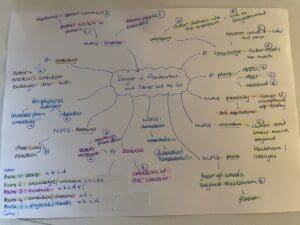
Paragraph 1: Setting a,b,c,d,e,f,
Paragraph 2: Characterisation a,b,c,
Paragraph 3: Narrative Voice a,b,c,d,e,f,g,
Paragraph 4 : Time a,b,c,d,e
Conclusion
From this, you can also see any sections which might be lacking in content. i.e. I would need to look for more evidence/ideas in the section on characterisation.